.avif)
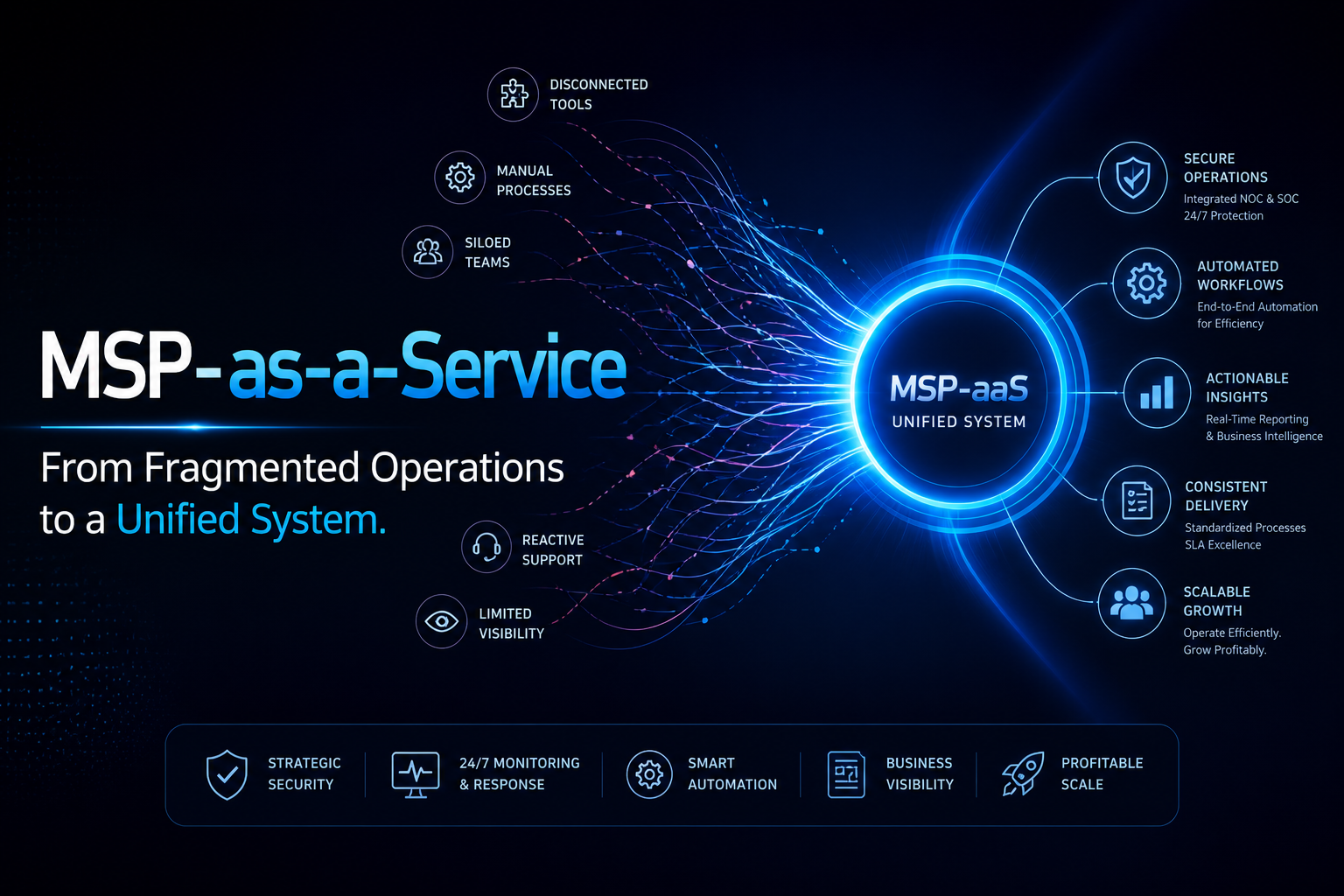

Most MSPs, when they’re trying to scale, are not limited by demand, or talent, or challenging projects. What often truly limits them is how their business is fundamentally structured.
Today’s MSP is expected to deliver cybersecurity, compliance, automation, 24/7 support, and business-level reporting. Yet most are still operating on a model built around disconnected tools, manual workflows, and technician-dependent execution.
According to a ConnectWise study, over 60% of SMBs rely on external providers for IT and security services. Expectations are rising, but the way MSPs operate doesn’t let them keep pace with the AI era that brings both opportunities and security challenges for their customers.
That’s why we have introduced MSP-as-a-Service (MSP-aaS), a fully integrated operating model that combines execution, tooling, and service delivery into one coordinated system. Instead of building operations internally, MSPs plug into a structured framework that already aligns NOC, SOC, automation, and business processes.
This guide explains what MSP-as-a-Service actually is, why it exists, and how it changes the way modern MSPs scale.
Why does MSP-as-a-Service Exist?
The MSP industry has evolved, but the underlying operating model has not.
MSPs are now responsible for:
- Endpoint and identity security
- Compliance and risk alignment
- Continuous monitoring and response
- Automation-driven service delivery
- Client reporting and advisory
At the same time:
- Tool costs are increasing
- Security expectations are higher
- Hiring experienced engineers is difficult
- Margins are tightening
Most MSPs respond by adding more tools or hiring more staff.
This leads to:
- Vendor sprawl
- Integration fatigue
- Inconsistent service delivery
- Operational overhead that grows faster than revenue
MSP-as-a-Service exists because the problem is not capability. It is coordination.
What is MSP-as-a-Service?
MSP-as-a-Service is an operating model where MSPs deliver services through a unified system instead of managing separate tools, vendors, and internal teams. It integrates execution, automation, security, and reporting into one coordinated architecture.
MSP-as-a-Service is built to remove the hyperfocussed dependence on a bundle of tools alone for MSP business owners to scale and serve clients better. It is a structured operating model that integrates all core functions of an MSP into one system.
It brings together four critical layers:
1. Execution Layer
NOC, SOC, and service desk operations are delivered through a structured, white-label execution engine powered by NOCDOC.
2. Tooling Layer
RMM, PSA, security, and documentation platforms aligned into a unified framework instead of operating independently.
3. Process Layer
Standardized workflows including SLA enforcement, escalation paths, automation logic, and service delivery consistency.
4. Business Layer
Reporting, QBRs, compliance visibility, procurement alignment, and operational insights.
The result is not just better tooling. It is a coordinated system where all components operate together.
How MSPs Typically Operate vs MSP-as-a-Service
Most MSPs do not consciously design their operating model. It evolves over time through tool additions, hiring decisions, and reactive changes.
The difference becomes clear when you compare both approaches side by side.
Traditional MSPs build their operations piece by piece. MSP-as-a-Service provides the system upfront.
How MSP-as-a-Service Works in Practice
Let’s now look at how MSP-aaS redefines the typical MSP business model with a postmodern, high-impact structured approach by seeing how it works in real operating context.
Step 1: Replace Fragmentation with Orchestration
Most MSP environments are built on disconnected tools.
MSP-aaS introduces orchestration across all systems, ensuring that tools, workflows, and execution operate as one coordinated unit.
Step 2: Plug Into a Structured Execution Engine
Instead of building internal teams for NOC, SOC, and service desk, MSPs connect to a structured execution layer.
This layer, powered by NOCDOC, provides:
- 24/7 U.S.-based operations
- White-label service delivery
- Escalation management
- SLA enforcement
- Security operations execution
MSPs retain full client ownership.
Execution happens within a controlled system.
Step 3: Standardize Service Delivery
Service delivery becomes process-driven instead of technician-driven.
This includes:
- Defined ticket workflows
- Structured escalation paths
- Consistent response standards
This removes variability across clients and technicians.
Step 4: Integrate Automation Across the Lifecycle
Automation is not limited to scripts.
It operates across:
- Monitoring to ticket creation
- Ticket to resolution workflows
- Resolution to reporting and insights
This reduces manual intervention and improves consistency.
Step 5: Align Security and Compliance
Security is integrated into operations rather than layered on top.
This includes:
- Endpoint protection alignment
- Identity and access control
- Continuous monitoring and response
- Compliance visibility
This ensures that security is consistently applied across all clients.
Step 6: Extend Into Business Operations
MSP-aaS goes beyond technical execution.
It supports:
- QBRs and client reporting
- Procurement and vendor alignment
- Compliance tracking
- Business insights and performance visibility
This allows MSPs to operate as strategic partners, not just service providers.
What Are The Key Advantages of MSP-as-a-Service
Here are 7 key advantages that every MSP business owner should know when considering becoming an MSP-aaS partner.
1. Scale Without Hiring
Growth no longer depends on continuously adding engineers. Execution capacity expands through the operating model.
2. Predictable Cost Structure
Costs become more aligned with a per-seat or per-client model instead of fluctuating labor expenses.
3. Reduced Vendor Complexity
Tools are aligned into a system, reducing integration overhead and management burden.
4. Embedded Security Operations
Security is part of the operating model, not a separate layer.
5. Operational Consistency
Service delivery follows defined processes, reducing variability and improving reliability.
6. Faster Time to Maturity
MSPs can operate at a higher level of maturity without building infrastructure over years.
7. Leadership Focus and Relief
Less time is spent managing operations, allowing leadership to focus on growth, clients, and strategy.
Key Takeaways
- MSP-as-a-Service is an operating model, not a tool or vendor bundle.
- It integrates execution, tools, processes, and business functions into one system.
- It enables MSPs to scale without increasing operational complexity.
- Security and automation are embedded within the model.
- It shifts MSPs from technician-led operations to system-driven delivery.
Conclusion
MSP-as-a-Service represents a fundamental shift in how managed services are delivered.
Instead of building operations piece by piece, MSPs operate within a structured system designed for consistency and scale.
This requires a change in mindset. It means moving away from assembling tools and toward adopting an operating model.
Platforms like MSP-aaS provide that foundation, enabling MSPs to operate with greater clarity and structure.
The future of the MSP industry will not be defined by who has the most tools.
It will be defined by who operates the best system.
Get in touch with MSP experts
See how MSP-aaS can help you simplify operations, improve service delivery, and create a more predictable business model. Book a guided walkthrough to explore how the platform works in practice. https://msp-aas.com/demo
FAQ
What is MSP-as-a-Service in simple terms?
MSP-as-a-Service is a structured operating model that allows MSPs to deliver services through a coordinated system instead of building operations internally.
How is MSP-aaS different from traditional MSP setups?
Traditional MSPs assemble tools and teams independently. MSP-aaS provides a unified framework where execution, tools, and processes are already aligned.
Do MSPs lose control of their clients?
No. MSPs retain client relationships, branding, and ownership while using the model to support service delivery.
Is MSP-aaS suitable for smaller MSPs?
Yes. Smaller MSPs benefit by accessing enterprise-level capabilities without building large internal teams.
How does MSP-aaS impact profitability?
By reducing operational inefficiencies and standardizing delivery, MSP-aaS improves margin predictability.
For the first time ever, a model that lets you work on your business, not in it.
MSP-aaS gives modern service providers the structure to scale, standardize, and lead.